

Don’t Click That!
Your Team Is One Click Away From Handing Your Business to a Criminal.
A no-nonsense course in spotting scams, phishing, and social engineering —
with a hands-on workbook to make it stick.
Two books. Zero jargon. One price. €39.
THE SETUP
Here’s a number: 39%.
That’s the percentage of business breaches that start with social engineering.
Not some genius hacker breaking through a firewall.
A person. Clicking a link. Opening an attachment. Wiring money because an email said to.
It doesn’t matter how good your security software is.
One employee clicking one bad link bypasses all of it in a single second.
And the emails don’t look like scams anymore.
In 2025, AI-powered phishing rose by 400%.
The spelling mistakes are gone.
The dodgy formatting is gone.
The emails look like they came from your bank, your supplier, your boss. Because someone spent five minutes on your LinkedIn profile and wrote one specifically for you.
It’s like putting a state-of-the-art lock on your front door and then handing the key to the first person who knocks and says “I’m from the gas company.”
THE BUNDLE
Two Books. One Goal. A Team That Doesn’t Fall For It.
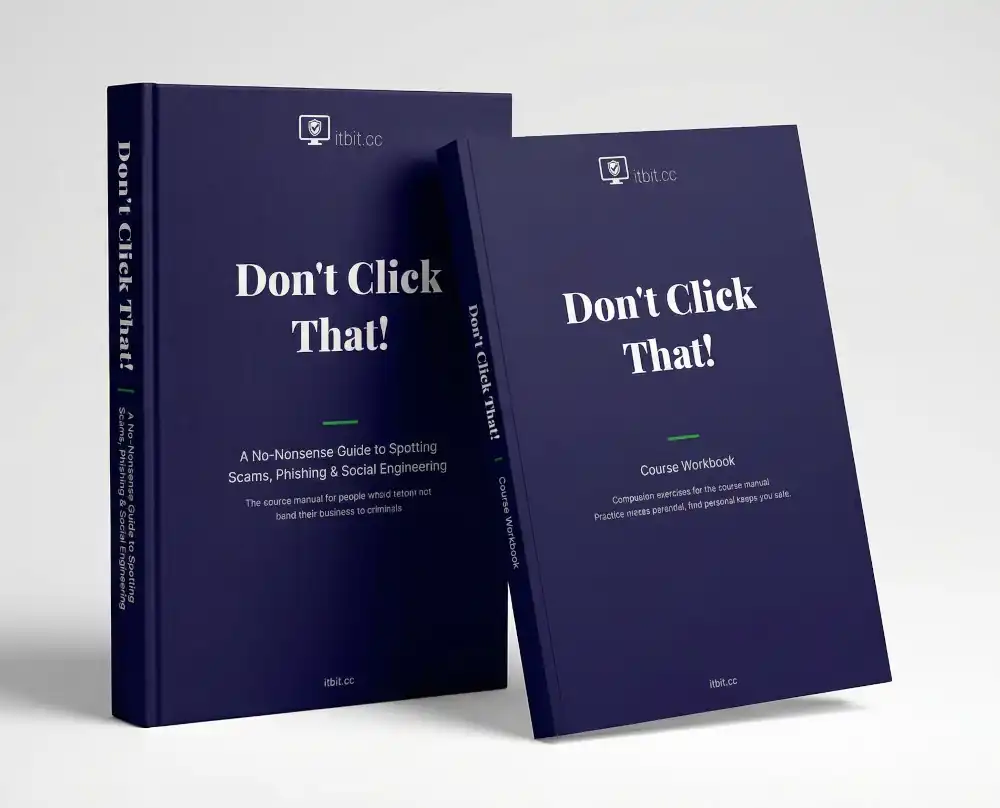
“Don’t Click That!” is a course, not just a book. It comes in two parts that work together:
The Course Manual is 34 pages of real-world scam breakdowns — how they work, what they look like, and exactly what to do when you spot one.
Every chapter ends with a clear action list.
No theory. No fluff. Just “here’s the scam, here’s the red flag, here’s what you do.”
The Course Workbook is 25 pages of hands-on exercises — fake phishing emails to analyse, vishing scripts to dissect, role-play scenarios for your team, and a monthly quiz template you can reuse.
Because reading about scams is useful.
Practising spotting them is what actually keeps you safe.
They’re sold together because they belong together.
The manual teaches. The workbook trains.
One without the other is like reading the driving theory and never getting behind the wheel.
WHAT’S INSIDE — THE COURSE MANUAL
15 Chapters. Every Scam Your Team Needs to Recognise.
- Why You’re Reading This — $4.88 million: the average cost of a phishing breach. 43% of small businesses attacked in the past year. And it almost always starts with a human mistake.
- How Scammers Think — They have KPIs, budgets, and customer support. Phishing kits sell for $50 with money-back guarantees. This chapter explains the six emotions every scam exploits.
- Classic Phishing Emails — The “Dear Customer” special. How to spot fake senders, suspicious links, and urgency traps — even when AI wrote the email.
- Spear Phishing — When they know your name, your project, and your colleague’s email signature. Targeted, personal, and devastatingly effective.
- Business Email Compromise — The single most expensive email fraud in the world. $8.5 billion lost in three years. The CEO didn’t send that email. But it looked exactly like he did.
- Invoice Fraud — 45% of all fraudulent payments. Quiet, boring, and it works because paying invoices is routine and nobody double-checks the bank details.
- Vishing — Voice phishing. When the phone rings and someone who sounds very official asks for your verification code. Spoiler: your bank already knows your date of birth.
- Deepfake Voice Calls — A finance director wired $243,000 because the CEO’s voice told him to. Except it wasn’t the CEO. It was AI. And that was 2019 — the technology is better now.
- Tech Support Scams — Microsoft is not calling you. Neither is Apple. Neither is your internet provider. This chapter is short because the answer is always the same: hang up.
- Social Media Scams — Fake customer support accounts, LinkedIn job scams, giveaway fraud, and cloned profiles. Trust no DM.
- Fake Websites & Online Shopping — Lookalike login pages, too-good-to-be-true shops, and typosquatting. How to check a URL before it checks your bank account.
- QR Code Scams (Quishing) — The newest one. Fake QR codes on parking meters, delivery notices, and in emails. You can’t see where it leads before you scan it. That’s the point.
- Building a Human Firewall — How to train your team without boring them to death. Short, frequent, safe to report. The opposite of a two-hour annual lecture.
- Incident Response Cheat Sheet — What to do in the first 15 minutes, the first hour, and the first day. Plus a key contacts table to fill in before you need it.
- Quick Reference Guide — A one-page tear-out with universal warning signs, the response protocol, and a quick-reference table for every attack type. Pin it to the wall.
WHAT’S INSIDE — THE WORKBOOK
16 Exercises. Because Reading About Scams Isn’t the Same as Spotting Them.
The workbook turns knowledge into reflex. Here’s what your team will actually do:
Analyse fake phishing emails — Four realistic examples. Spot the red flags. Decide: legitimate or phishing? Harder than you think when the AI wrote it.
Inspect a fraudulent invoice — Two invoices side by side. One real, one fake. Find the five differences before you wire the money to the wrong account.
Role-play a BEC attack — One person plays the scammer, one plays the target. Three minutes. See how far social engineering gets when it’s aimed at your own team.
Write your own phishing email — Yes, really. The best way to understand how it works is to build one yourself. Then swap with a colleague and try to spot each other’s tricks.
Dissect vishing scripts — Three phone call transcripts. Find the red flags. Practise the words you’ll use to hang up — because “I’m going to call you back on your official number” is harder to say out loud than you’d expect.
Run the Scam Scenario Gauntlet — Eight real-world scenarios. Sixty seconds each. What do you do? A team exercise that’s more useful than any security lecture.
Build your incident response card — Fill in your key contacts, your reporting process, your code word, and your payment approval threshold. Before you need them.
Create a one-page security policy — Using everything you’ve learned. If it’s longer than one page, nobody will read it.
WHO THIS IS FOR
For Teams That Have Better Things to Do Than Get Scammed.
You run a business. You have a team.
Some of them are careful with emails.
Some of them click first and think later.
Most of them have never had any training on this — because who has time for that?
This course is designed for teams of any size, in any industry, with any level of technical knowledge.
It’s written in plain English.
The exercises take minutes, not hours. And the workbook is designed to be reused — monthly quizzes, team scenarios, and drills you can run again whenever you hire someone new.
You don’t need an IT department to use this. You need a printer, a meeting room, and about two hours.
THE STAKES
The Numbers Behind the Clicks.
$4.88 million — the average cost of a phishing breach.
$8.5 billion lost to business email compromise in three years.
$25 million stolen in a single deepfake video call.
57% of businesses hit by BEC attacks in 2024.
A 400% rise in AI-powered phishing in one year.
And behind every one of those numbers is a person who made a very understandable mistake.
They weren’t stupid. They were busy. They were trusting. They were doing their job.
And someone exploited that.
The scams in this course are real. The red flags are learnable. And the difference between a team that’s been trained and one that hasn’t is the difference between “we caught it” and “we wired the money.”
WHAT DOES IT COST
€39. For Both Books. For Your Entire Team.
You buy it once.
You train everyone.
The course manual explains every scam.
The workbook makes your team practise spotting them.
You can reuse the exercises every month, every quarter, every time you onboard someone new.
The average invoice fraud costs thousands.
A single BEC attack can empty an account.
A phishing breach averages $4.88 million.
This course is €39.
That’s less than the lunch you’d buy the IT consultant who tells you the same things — except they’d charge by the hour and use more acronyms.
WHAT IF…
“We already have security software.”
Good. This course covers the attacks that security software can’t stop — the ones that trick people, not machines. Your firewall doesn’t help when someone reads a verification code to a scammer over the phone.
“My team is too small for formal training.”
The workbook exercises work with as few as two people. Some are individual. The smaller the team, the more damage one wrong click can do — and the more this matters.
“We don’t have time for security training.”
The course manual reads in under an hour. The workbook exercises take 5–15 minutes each. You can spread them across a month of five-minute team briefings.
You have time. You just haven’t been spending it on this.
SO
Every scam in this course has worked on someone.
Most of them have worked on someone smart, experienced, and careful.
The difference isn’t intelligence. It’s training.