Did you really lock it?
Your website, that is. Not the front door.
Before a holiday, everyone is a security expert. Gas off, iron unplugged, windows shut. Then twenty kilometres down the road comes the question: did I lock the door?
With a website, that question somehow never comes up. It’s built, it works, it looks good. Has anyone checked since whether it’s locked?
…Nobody? I thought so.
“Who on earth would want to hack us?”
Nobody. At least nobody with a face.
Most internet traffic today isn’t made by people but by programs. According to the 2025 Thales/Imperva report, 51% of all web traffic was already automated in 2024, and 37% of it came from malicious bots.
These bots try one door handle after another, day and night. The family bakery’s just like the multinational’s. Wherever they find something open, they walk in.
Not because you are the target. Because the door was left open.
What do they take?
Your customer list.
Your passwords.
Your company’s good name, built over years – so they can run scams under it.
Your partners’ trust, your money, your server’s resources and your peace of mind.
Worst of all, you often don’t even notice. From the outside the site looks just as good as it did yesterday. Meanwhile it’s quietly infecting your visitors.
Faster than you think
When a vulnerability in a WordPress plugin gets known, the average time window before the mass attacks begin is 5 hours (Patchstack).
Not five weeks, not five days. Five hours.
Knowing that, “I check on it once a month” is a holiday, not maintenance.
I’m not blaming you. It’s just that you run your business, not the server. And that’s exactly what they exploit.
Not because you matter to them. Because there are so many of you, and so many of you leave the window open.
Check it before they do
The free Scan walks around your site from the outside, just like the hackers’ bots. Except it doesn’t go in. Instead, it tells you what it found – in plain language, no tech mumbo-jumbo.
- A minute, not an afternoon. You get the result in under 60 seconds.
- No keys needed. No registration, WordPress login or installation. Just your site’s address, your name and an email address, so we know where to send the report.
- Looks, doesn’t touch. It checks passively, from the outside: it doesn’t try to break in, doesn’t guess passwords and changes nothing on your site.
- It looks at what hackers look at. Outdated plugins and themes (checked against the list of known vulnerabilities), WordPress version, SSL certificate, security settings, accessible files, login protection.
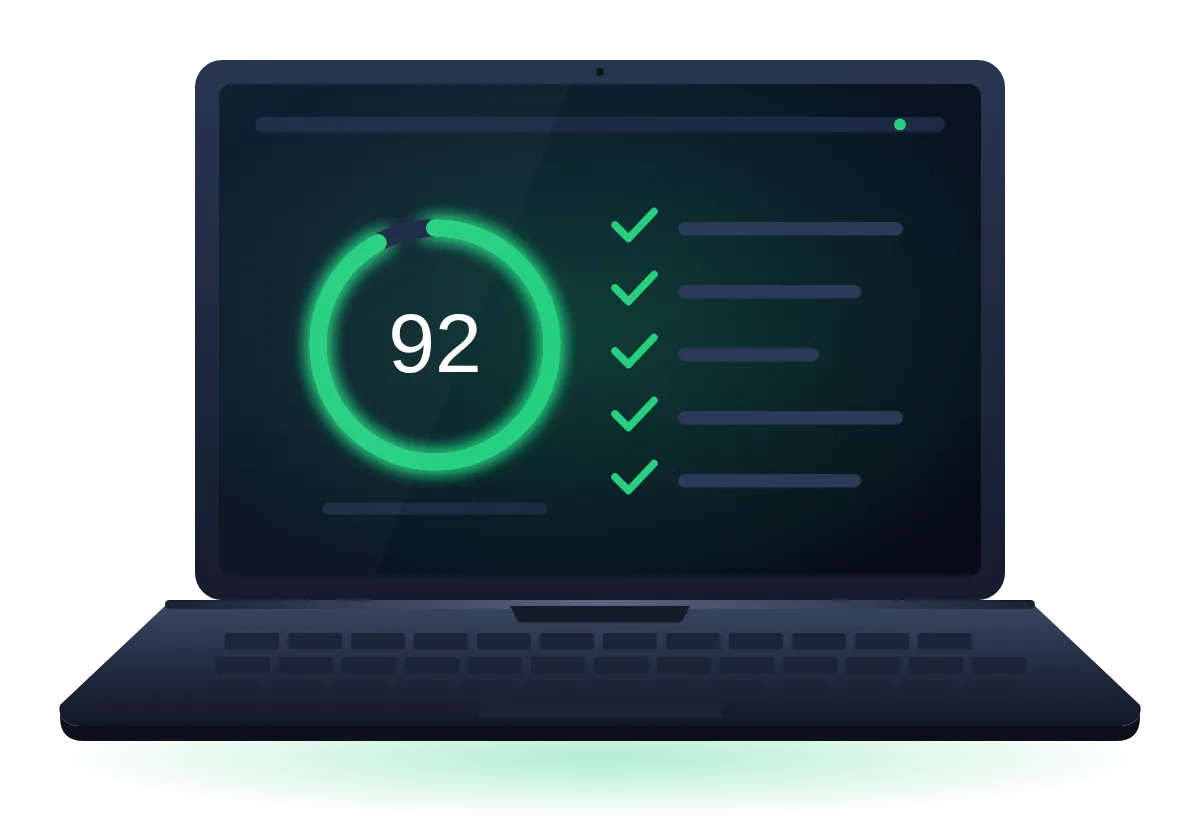
- It uses plain English. You get a score, and for every problem it explains what’s wrong. In a PDF too, which you can forward to your IT person (let them sweat a little too).
If everything is fine, you can relax. If not, at least you didn’t hear it from the bots.
Don’t like what you see?
Switching off the monitor is not a solution. (Tried and tested.)
You have two things to do: lock the doors, and make sure they stay locked. The good news is that you don’t have to do either. Just nod.
1. Security Lockdown – we lock up whatever was left open
It’s like someone actually walking around the house before you leave. Not by feel, not “I think so”, but checking door, window, cellar, garage, back gate – even the cat flap.
It goes over your site from cellar to attic, and fixes, updates, configures and locks down whatever it can.
All you have to do is take the key at the two-step login, and it walks you through those few clicks too. You don’t even need to understand IT – just find your phone.
Before we touch anything, a full backup of the site is made. Because we don’t work on the “I’m sure I locked it” principle.
- usually done within 24–48 hours
- one-off work, not a subscription
- at the end you get a clear before-and-after report
- your money back within 14 days, no questions asked
2. Sentinel – the guard who never falls asleep on duty
Remember the five hours? That’s why checking once a month isn’t enough.
Sentinel makes its rounds every hour. It checks whether a new update has come out or a new vulnerability has been found, and it updates too – after making a backup, of course. Every day it looks for malware, tells you if a new administrator suddenly appears or someone logs in strangely, and lets you know if the site goes down.
It doesn’t take holidays, doesn’t call in sick, and isn’t grumpy on Monday morning. In fact, that’s exactly when it sends the weekly report. And if something really goes wrong in between, it doesn’t wait until Monday: it tells you right away by email or Telegram.
Nobody can guarantee that your site will never be broken into. What we can guarantee is a trained guard watching day and night – one that speaks up before your customers do.
The first step is free
One minute, and you know where you stand. Your coffee won’t even have time to go cold.
Already hacked?
Then stop looking for new locks, you need to throw out the bugger and start cleaning. We rebuild the site from clean, official sources, quarantine the suspicious code, change the passwords, and keep watching for 30 days to make sure the uninvited guests don’t come back. We stop the damage as fast as possible.