

Hooked On Security
Your Website Has a Door.
Do You Know Who’s Trying the Handle?
A short, no-jargon guide to why hackers target small businesses — and what you can actually do about it.
8 chapters. Plain English. Zero cost. FREE.
Signing up is FREE
THE SETUP
There’s a myth floating around the internet that’s costing small businesses a fortune.
It goes like this:
“Hackers go after big companies. We’re too small to be on their radar.”
It sounds reasonable. Logical, even. Like assuming burglars only rob mansions.
Except burglars don’t only rob mansions.
They rob the house with the unlocked back door.
The one with no alarm.
The one where nobody’s home.
They don’t care if the silverware is worth ten thousand or ten euros — if the door’s open, they walk in.
That’s exactly how it works online.
Automated bots scan thousands of websites every hour, looking for outdated plugins, weak passwords, and open doors.
They don’t check your revenue first.
They check your defences.
And if those defences aren’t there? They’re in.
Your website might be small. But to a bot, it’s just another door to try.
THE BOOK
This Book Is the Conversation Your Web Developer Never Had With You.
You had a website built. Someone “took care of” security. And that was the last time anyone mentioned it.
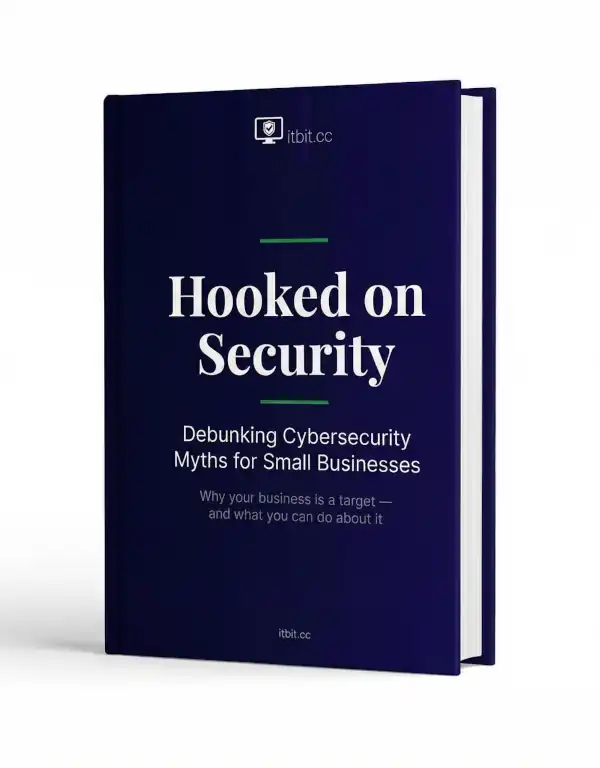
“Hooked on Security” is 22 pages of plain-English truth about what’s actually happening to small business websites — who’s attacking them, why, and what you can do about it without needing a computer science degree.
No jargon. No scare tactics for the sake of it.
Just the stuff you should’ve been told from the start, explained with everyday analogies and the occasional dry joke.
WHAT’S INSIDE
8 Chapters. Each One a Reason to Stop Assuming You’re Safe.
- Introduction — Debunking the Myths — The “we’re too small to be a target” myth, why it’s wrong, and the fence-and-locks analogy that puts it in perspective. Spoiler: the fence isn’t enough.
- Small Businesses as Targets — Five reasons hackers love small companies. Not because of what you have — but because of what you don’t. Your neighbour stealing your electricity, except it’s your server.
- Why Do They Want to Break In? — Seven ways hackers make money from your website. Ransomware, phishing, crypto mining, SEO fraud, credential theft — and the one where they send your clients invoices with their bank details instead of yours.
- Who Are These Fookers? — The three types of attackers: the human hacker (rare but dangerous), the bot (relentless and everywhere), and the botnet (thousands of zombie computers attacking at once). Yes, “fookers” is the technical term.
- How to Defend — Part One — Passwords, two-factor authentication, limiting access, and deleting accounts nobody uses anymore. The stuff that sounds obvious but almost nobody actually does.
- How to Defend — Part Two — Where to get your software, why your hosting provider matters, how backups work (and why you should test them), and the single most important thing: a web application firewall. Explained without the acronym soup.
- The Remaining Weak Spots — Even Fort Knox can theoretically be broken into. What’s left after you’ve done everything right — and why it’s still not a reason to do nothing.
- How Can itbit.cc Help? — A free 25-point security check for your website. No commitment. No credit card. Just a PDF showing you exactly where you stand.
WHO THIS IS FOR
For People Who Built a Website and Then Got On With Their Lives.
You’re a business owner. You sell things, or provide services, or help people.
You built a website because that’s what you do in 2026. Someone set it up. It works. You update the blog occasionally. You haven’t thought about security since the day it launched.
You’re not irresponsible. You’re busy. There’s a difference.
But the bots scanning your website at 3am don’t know that — and they don’t care.
This book is for you. It’s written in the same language you use with your friends, not the language your IT department uses with each other. It takes about 30 minutes to read. And it might save you thousands.
THE STAKES
It’s Not Just Your Website. It’s Your Business.
When someone breaks into your website, they don’t just deface a page.
They steal your customers’ data and sell it.
They install malware that infects your visitors.
They hijack your search rankings so Google stops showing your site altogether.
They encrypt everything and demand a ransom.
And here’s the part nobody talks about: your customers don’t blame the hacker. They blame you. Because it was your website. Your responsibility. Your door that was left open.
The average cost of recovering from a breach starts at €500 and climbs fast.
The cost of lost trust? That one doesn’t have a price tag.
WHAT DOES IT COST
Free. Because Knowing This Stuff Shouldn’t Cost You Anything.
This ebook is free.
No email sequence.
No upsell on page three.
No “but wait, there’s more.” Just 22 pages of useful information that could save your business from a very expensive bad day.
We wrote it because too many small business owners don’t know they’re at risk. And by the time they find out, it’s usually because something has already gone wrong.
Consider it a public service announcement — with better jokes.
Signing up is FREE
WHAT IF…
“I already have a security plugin.”
Good start. Chapter 5 explains why that’s necessary but not sufficient. A security plugin is a lock on the front door. This book shows you all the other doors you didn’t know existed.
“My site is too small to be a target.”
That’s Chapter 2. Short version: bots don’t check your company size. They check your plugins. If one is outdated, they’re in. They’ve scanned your site already — probably this week.
“I don’t have time to read about security.”
It’s 22 pages. You’ll spend more time this week scrolling past things that matter less. And it’s written in plain English — no glossary required.
SO
Your website is either protected or it isn’t. Right now, you might not know which one it is.
This book takes 30 minutes. The alternative takes a lot longer.
Signing up is FREE
How vulnerable is your website? Run our free scanner and find out in 60 seconds!
If you want to take care of strengthening your website’s security, you can check out our DIY Security Guide. It will help you every step of the way – in plain English.
Or you might want us to handle it for you. In that case, check out our offers on the Security Lockdown package.