

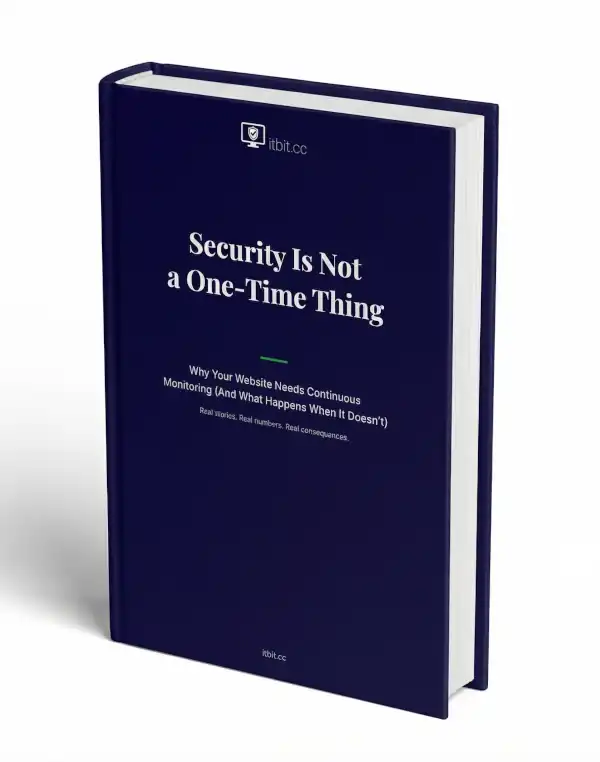
Security Is Not A One-Time Thing
You Secured Your Website Once.
That Was the Problem.
Real stories. Real numbers. Real consequences.
A short book about the gap between “I installed a security plugin” and “my website is actually secure.” €19.
THE SETUP
You installed a security plugin.
You changed the default password.
Maybe you even turned on two-factor authentication.
Then you made a coffee, leaned back, and thought: “Right. That’s sorted.”
That was six months ago. Maybe a year. Maybe longer.
Here’s the thing about website security: it has an expiry date. And it doesn’t print one on the label. The plugin you installed is only as good as the threats it knew about on the day you installed it. Tomorrow, there’ll be new ones.
It’s like fitting a smoke alarm and never checking the battery. The alarm was a good idea. It’s just not doing much if the battery died eighteen months ago.
THE BOOK
This Book Is About That Gap.
The gap between “I secured my website” and “my website is secure.”
One is a moment.
The other is a process. And the difference between the two has cost real companies real money — sometimes their entire existence.
This isn’t a technical manual. It’s 18 pages of real stories, real numbers, and the uncomfortable truth about what happens when nobody’s watching.
WHAT’S INSIDE
10 Chapters. Each One A Reason To Stop Ignoring This.
- The Uncomfortable Truth — You set up security once and moved on. So did everyone else. Most of them were wrong. The smoke alarm analogy that’ll change how you think about your website.
- The Numbers Don’t Lie — 11,334 new vulnerabilities in 2025. Up 42% from last year. 91% in plugins. And 46% had no patch available when they were discovered. Sleep well.
- The Law Firm That Lost Everything — The Panama Papers. 11.5 million documents leaked. The cause? A WordPress plugin that hadn’t been updated in three years. The firm closed its doors. The patch had been available the entire time.
- 1.5 Million Pages in Two Weeks — A WordPress vulnerability was patched. The patch notes were deliberately vague to buy time. It didn’t matter. Twenty hacking groups reverse-engineered it anyway. 1.5 million pages defaced. The fix was free and took seconds.
- The $1.38 Billion Patch — Equifax. Patch released March 7th. Breach started in May. 147.9 million people exposed. The two-month gap between “patch available” and “patch applied” cost one point three eight billion dollars.
- 22 Lines of JavaScript, 380,000 Stolen Cards — British Airways. Magecart. A tiny script injected into the payment page. Nobody noticed for 15 days. The fine was £183 million. The lesson: security that isn’t monitored isn’t security.
- The Five-Hour Window — The median time from vulnerability disclosure to mass exploitation is now five hours. Not five days. Five hours. If you’re checking your dashboard once a month, you might as well not be checking at all.
- Why “Set and Forget” Doesn’t Work — Because threats don’t stop evolving when you stop paying attention. A clear explanation of why one-time security is a contradiction in terms.
- What Continuous Monitoring Actually Looks Like — Not what you think. Not expensive. Not complicated. Just consistent. What it means in practice, without the sales pitch.
- What You Can Do Right Now — Concrete, actionable steps. No jargon. No “consult your developer.” Things you can do today, before you finish your coffee.
WHO THIS IS FOR
For People Who Thought They Were Done.
You’re a business owner, not a security researcher.
You built a website because you needed one, not because you wanted a second job maintaining it.
You did the responsible thing — installed security, set strong passwords, maybe even read an article or two.
And then life happened. You had a business to run. The website kept working. So you stopped thinking about it.
This book is for you.
It’s a wake-up call wrapped in real stories, written in plain English, and short enough to read in a single sitting.
THE STAKES
The Stories in This Book Have One Thing in Common.
A law firm that operated for 40 years — gone.
1.5 million web pages defaced in a fortnight.
380,000 credit cards stolen through 22 lines of code. A $1.38 billion settlement.
Every single one of these was preventable.
Not with expensive software.
Not with a team of engineers.
With monitoring. With someone — or something — paying attention.
The fix existed in every case. It just hadn’t been applied.
WHAT DOES IT COST
€19. Cheaper Than Finding Out the Hard Way.
The average cost of recovering from a website breach starts at €500 and goes up fast.
The cost of lost customer trust? You can’t put a number on that.
Actually, Equifax did. It was $1.38 billion.
This book is €19. That’s less than a month of the streaming service you forgot to cancel.
WHAT IF…
“I already have a security plugin.”
Good. So did the law firm in Chapter 3. The plugin worked fine. It just wasn’t enough on its own — because nobody was watching what happened after it was installed. This book explains why.
“My site is too small to be a target.”
The 1.5 million pages defaced in Chapter 4 included small blogs, local businesses, and personal sites.
Bots don’t check your revenue before they attack. They check your plugins.
“I’ll just deal with it if something happens.”
That’s the Equifax strategy. It cost them $1.38 billion. Yours probably won’t cost that much. But it’ll cost more than €19.
SO
Security isn’t a moment. It’s a process.
You either watch your website, or someone else will.
If you want to take care of strengthening your website’s security, you can check out our DIY Security Guide. It will help you every step of the way – in plain English.
Or you might want us to handle it for you. In that case, check out our offers on the Security Lockdown package.